
One of the defining characteristics of each generation is the slang words that are popular with them. YOLO. Lit. Groovy. Far out. Rad. Rizz. Slay. Bummer. Ate. Wicked. These words can connect us, make us laugh, or create confusion. Above us, these words seem to have a cultural expiration date. When was the last time you heard someone say or type out the word YOLO?
Some of the most popular Gen Z slang terms are aura, banger, basic, fire, gagged, and many, many more. Gen Z *loves* their unique generational language.
I’ll address the elephant in the room right off the bat – I’m a ‘97 baby, someone stuck between millennial and Gen Z. I identify with both groups, especially when it comes to pop culture. I grew up loving High School Musical, One Tree Hill, and Glee and as an adult… also really love those things. With a new critical eye towards them, of course. But I also am having a Brat™ summer and love to unironically use the word slay at least a dozen times per day. That last one is a problem, honestly.
Gen Z is generally defined as children born between 1997 and 2012. Typically, Gen Z are the children of young baby boomers (like myself) or Gen X. If we’re following those years, Gen Z ranges from 12-27 years old. That’s quite a large gap, which partly explains why people born in the late 90’s may be caught off guard by what slang someone born in 2010 may use.
I’d be remiss to mention that a lot of Gen Z slang in particular does take inspiration from AAVE (African-American Vernacular English) and the queer community, specifically from drag queens. Slay, for example, is from the drag scene in the 80’s and 90’s. Thank you to the queens who came before us for these words.
As we get further into the 2020s, we’re getting more media revolved around Gen Z characters. Whether or not the actors playing these characters are Gen Z is a whole other debate. The examples I want to look at today are the show Pretty Little Liars: Original Sin and the movie Teenage Mutant Ninja Turtle: Mutant Mayhem.
Pretty Little Liars: Original Sin revolves around a group of teenage girls born in the 2000s. The girls are in high school and have varying interests – sports, horror films, dance, chat rooms, and, ya know, solving a 20-year-old mystery. Normal teen things.
One of the things I noticed the most while watching season 1 of PLL:OS was the excessive use of film quotes and references from the character, Tabby, in particular. Tabby works at the local movie theater and has a passion for film, horror films in particular. She almost excessively finds a way to tie everything back to a horror film throughout the season – telling herself she’s a “final girl” while entering a dark staircase, making a gender-swapped tribute to Psycho for her film class, or encouraging her classmates to attend a Jordan Peele double feature that she hosts.
Honestly, these references pretty much all landed for me. I don’t mind a little meta-commentary in a show, and her character reminded me a lot of the new characters we see now in slasher films like Scream VI. She’s the member of the group who thinks she’s smart enough to save everyone from the killer and she wants everyone to know that. She’s seen the classics, the remakes, and the reboots, and she can get them all out alive.
Many of the comments I saw about Tabby on the TV Time app expressed annoyance at her references and quotes. They ranged from wondering how a teenager could know all of these movies, to wanting her to shut up. In my experience, with the rise of apps like TikTok and Letterboxd, I think it’s more common for teenagers to watch a lot of films and have strong opinions of them. I genuinely believe that Tabby has seen all of the movies she’s referencing – now, do I believe all of the teens on the show have? Absolutely not. But it makes Tabby’s character stand out and ties back to her main plot line very well.
Throughout the show, we see a lot of arguing among the teens, particularly between boys and girls. We see boys telling girls to “chill out” and, in one particular confrontation, a boy asking if Tabby is trying to “win the award for angriest black girl.” I think this is a pretty good representation of how teenagers tend to argue these days – as a more socially conscious generation, Gen Z knows the hot topics to push while in a heated confrontation. When I was in high school, the boys would make misogynistic jokes, make fun of our feminist club, and tell us that “feminism wasn’t real.” I believe that teens today have an even sharper eye on contemporary gender dynamics and could draw on deeper social issues to cut deep and evoke a stronger reaction from their opponents.
Overall, I believe Pretty Little Liars: Original Sin is a good representation of Gen Z as a whole, particularly how they use, and occasionally weaponize language. The characters aren’t using slang just to use slang. Their dialogue feels more natural than that. Perhaps since the show is structured as more of a mystery than a comedy, we don’t see the writers trying to force in Gen Z slang to get a cheap laugh from the audience. We see the characters using it amongst themselves, either when they’re feeling comfortable or when they’re defending each other. The adults in the show aren’t using it to embarrass their kids and the mysterious “A” doesn’t use it in their texts to the girls. It’s used sparingly, which I think is the smartest thing that the writers could do.
Teenage Mutant Ninja Turtle: Mutant Mayhem takes almost the opposite approach to PLL:OS, to similarly successful results. Brothers Michelangelo, Leonardo, Raphael, and Donatello are chronically online teenagers who love to use Gen Z slang. They scroll TikTok, they roast each other constantly, and they spend their free time imagining what it would be like if they could be normal teenagers.
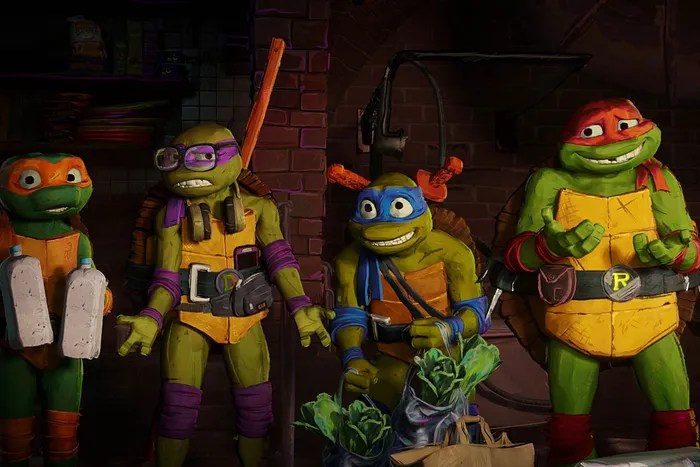
Teenage is a fascinating example because the voice actors for the mutants are actual teenagers! While recording their lines for the film, each actor was younger than nineteen years old. Their young voices, whether laced with sarcasm, melancholy, or longing are part of why this movie works as well as it does. You believe the brothers would gang up to tease Donatello for having no “rizz,” for example.
Teenage relies heavily on slang throughout the various character interactions in the film. Not only do the brothers use it amongst themselves, but they’re nervously using it while speaking to April (voiced by Ayo Edebri, our Irish queen) and while trying to connect with the new mutants they meet throughout the film. It slips out unconsciously, effortlessly fitting into the dialogue. That being said, I don’t believe it ever becomes too much or ever becomes cringe. And a movie like this could so easily become cringe.
I have to give a specific shoutout to the film’s writers for making this all seem so natural – Seth Rogen, Evan Goldberg, Jeff Rowe, Benji Samit, and Dan Hernandez. Bravo all around.
For every good example of good Gen Z representation, there are ultimately three bad examples. Screenwriters across the world are still trying to see what works and what doesn’t when it comes to media based on this age group. I hope that writers can see how Pretty Little Liars: Original Sin and Teenage Mutant Ninja Turtles: Mutant Mayhem utilize their teenage characters’ language, habits, and relationship dynamics and create even stronger media.
Pretty Little Liars: Original Sin is available to stream on Max. Teenage Mutant Ninja Turtles: Mutant Mayhem is currently available to stream on Amazon Prime.

 poptalkwithrach