Checking in With Megan Sussex: With Love, Meghan Season 2 & As Ever

Since I last wrote about Meghan Sussex, a lot has occurred. Rumors swirled about Meghan and Harry’s Netflix deal, season 2 of With Love, Meghan dropped, As Ever has had three more launches, and Meghan celebrated her 44th birthday. I’m here today with an update on all things business for our favorite Royal Girl Boss, along with my personal As Ever story! 

My disclaimer from my first Meghan post applies: I once again want to make it clear that any racist or hateful comments on this post regarding Meghan and her family will not be tolerated. 

The State of the Netflix Deal

On August 11, after weeks of speculation and false rumors, it was announced that Harry and Meghan had extended their working relationship with Netflix. The couple has a “multi-year, first-look deal via their banner Archewell Productions.” Additionally, Netflix will continue to work with Meghan to further develop the As Ever brand. 

In July, word spread that Netflix had chosen not to renew their $100 million deal that expired this month. Who spread this word? Well, an unnamed “Hollywood insider,” of course. This story originated in The Sun, a notorious U.K. tabloid. It’s shocking how many legitimate news outlets took this headline and ran with it, only to have to backtrack weeks later with the truth, this time directly from Netflix. I was particularly perplexed by People Magazine’s engagement with the rumors. People has been a trusted outlet for Harry and Meghan, with Meghan even appearing on the cover with exclusive photos and an interview ahead of the first season of With Love. But hey, clicks are clicks. 
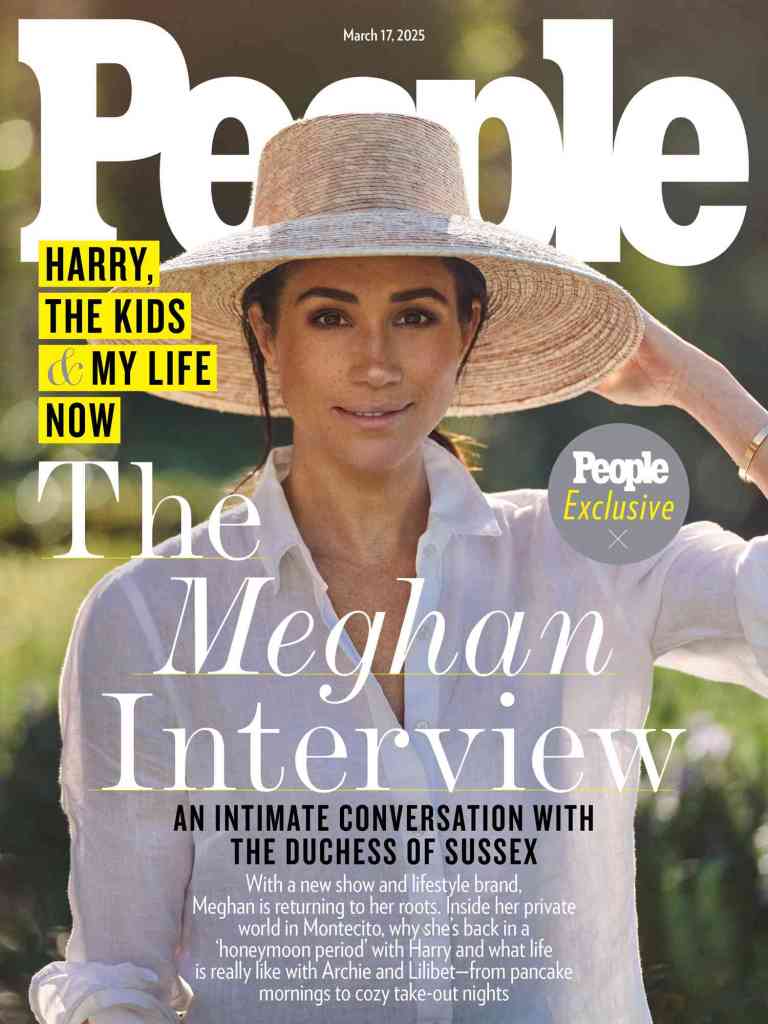
Meghan Sussex (Markle) on the cover of People Magazine, wearing a white button down shirt and a wide brimmed tan hat.
Meghan’s People cover from March ’25

The only real change that comes with this new deal is that Harry and Meghan have the opportunity to shop their projects to other networks and streamers, after showing them to Netflix first. If Netflix chooses to pass on a project, the couple can send it to Hulu, Paramount, etc. The royal couple isn’t the only one who has entered into this sort of deal with the streaming giant. Barack and Michelle Obama have a similar first-look deal with Netflix. Not a bad company to be in!

With Love, Meghan Season 2

With Love, Meghan season 2, premiered on Netflix on August 26. The new season boasted guests from Tan France to Samin Nosrat. Though this season was filmed at the same time as the first season, I believe the vibe in this season is even more joyful. Meghan seems much more comfortable in front of the camera this time and works alongside her guests with more confidence. She seems less nervous and more present. Similarly, the guests this season seem more confident as well. There doesn’t seem to be as much of a “starstruck” quality to the guests as there was in the first season (*cough* Mindy Kaling *cough*). Season 2 seems to be closer to what Meghan envisioned for the show – two or more people coming together and sharing in the love of food, entertaining, and friendship. 

The season 2 poster for With Love, Meghan

As of this writing, a third season of With Love hasn’t been announced. However, a holiday special of the show was revealed alongside the news of the couple’s new Netflix deal, named With Love, Meghan: Holiday Celebration. The special will air this December. 

The numbers from Season 1 of With Love arrived in July, with Netflix releasing its latest Engagement Report. With Love ranked 389th in the television category with 5.3 million views. You may look at that number initially and grimace, like I did. But I downloaded the entire report and was pleased to see the company that Meghan was in. At 410th is Beyoncé with the Beyoncé Bowl, and Gilmore Girls season 1 is 411th – believe me, y’all, Meg is doing just fine. 

As Ever Evolves Past Their Initial Launch

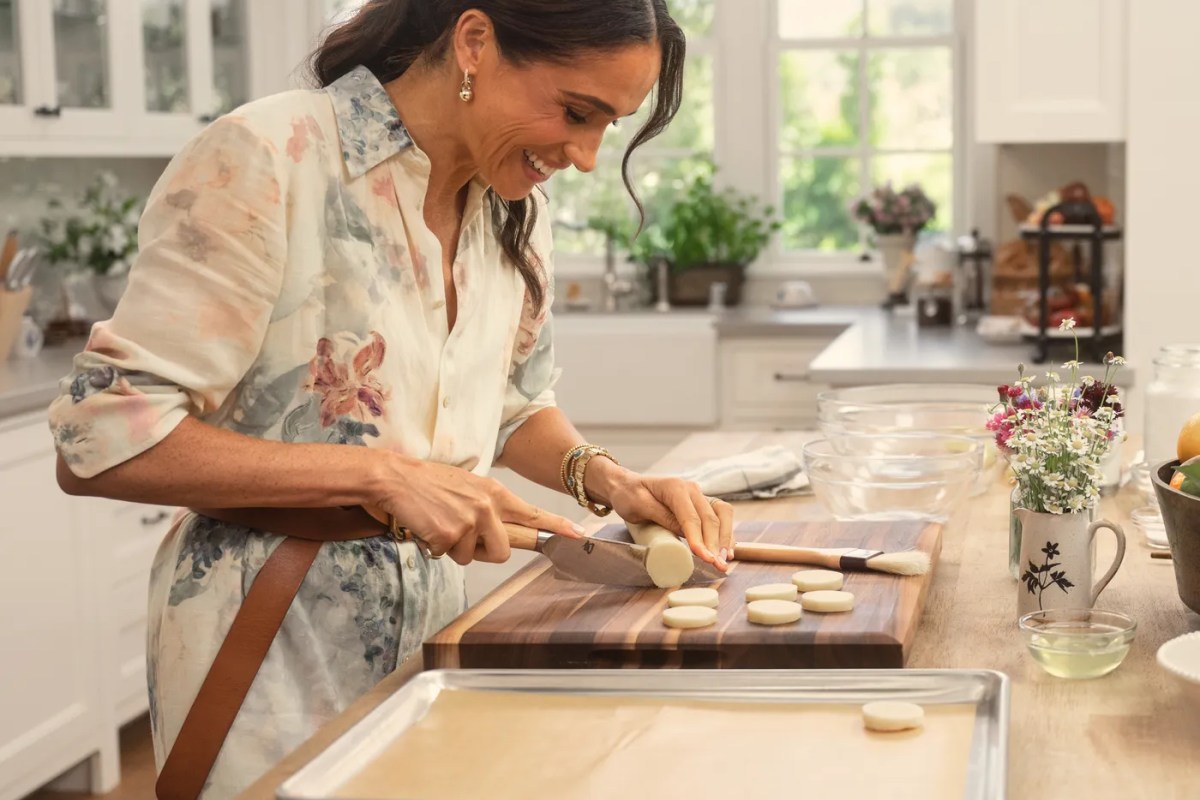
Since our last As Ever update, a lot has happened! There have been two more spread drops, along with a special wine launch. In June, an apricot spread was added to the As Ever family, and in August, an orange marmalade spread joined the fun. Each flavor drop was accompanied by a restock of the evergreen products – the shortbread cookies, the flower sprinkles, the crepe mix, and the tea. The 2024 Napa Valley Rosé launched this summer. The rosé is sold in bottles of 3, starting at $90. Let me tell you, I’m dying to try this wine, but the price is a little too steep for me at the moment. If you’ve had the opportunity to try it, please let me know in the comments. 

A screenshot from the As Ever website, featuring the crepe mi and herbal lemon ginger tea
A screenshot from the As Ever website from 9/9/25

Business wise, the second As Ever launch completely sold out, similar to the first launch. The third launch was accompanied by more stock, leading to only the orange marmalade spread in the keepsake packaging being sold out at the time of this writing. Meghan spoke about As Ever’s inventory with Emily Chang of Bloomberg, sharing how each launch has been a learning opportunity for the company. You never truly know what the demand for a product will be until you launch it. Essentially, As Ever went from launching with 10,000 jars of raspberry spread to producing 100,000 jars of the orange marmalade spread. That sort of growth in less than a year is extraordinary. 

With a holiday With Love special coming in December, I expect there to be a festive As Ever drop sooner rather than later. Cranberry spread? A gingerbread mix? The possibilities are endless. 

My Personal As Ever Experience

When the second launch for As Ever arrived on the morning of June 20, I had the website up and ready, prepared to sacrifice my firstborn child for some apricot spread. I was thrilled to check out with my apricot spread (in the keepsake packaging) within minutes, wiping my brow later that morning when I saw that the launch had once again sold out. Unfortunately, this moment of relief was not meant to last. 

I, along with many other customers, had their apricot spread orders cancelled a week later. I can’t lie, I was pretty bummed to receive that email. There wasn’t any nefarious reason for the cancellation, but the As Ever team told customers in an email that the spreads were oversold. They assured customers they would receive a refund for both the spread and for the shipping (which was $7 for me). On top of that, the team vowed that we would receive a spread upon restock, free of charge. I was skeptical of this claim, but nonetheless thrilled to receive a refund. 

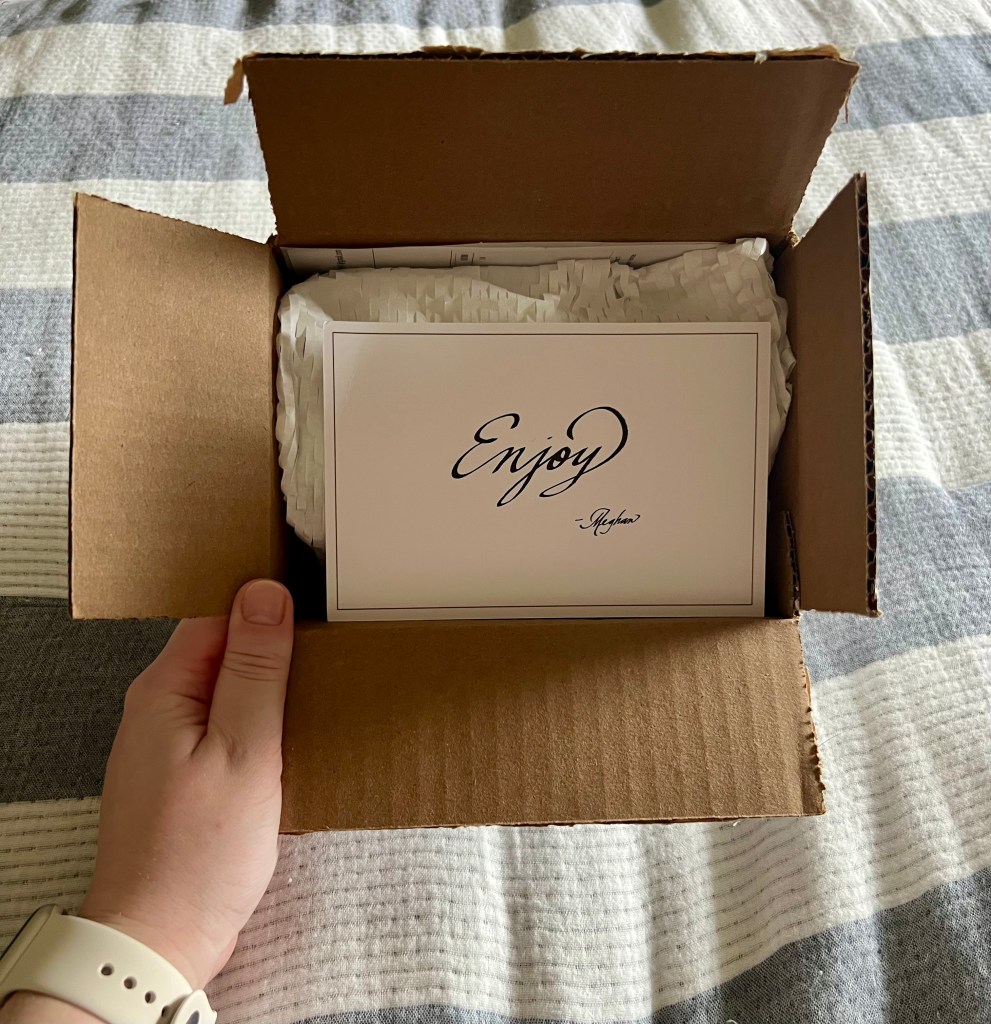
With the launch of season 2 of With Love, Meghan, the As Ever team contacted those with the cancelled orders to let them know that their spreads would be shipping within days. A week later, I received a special package in my mailbox. 

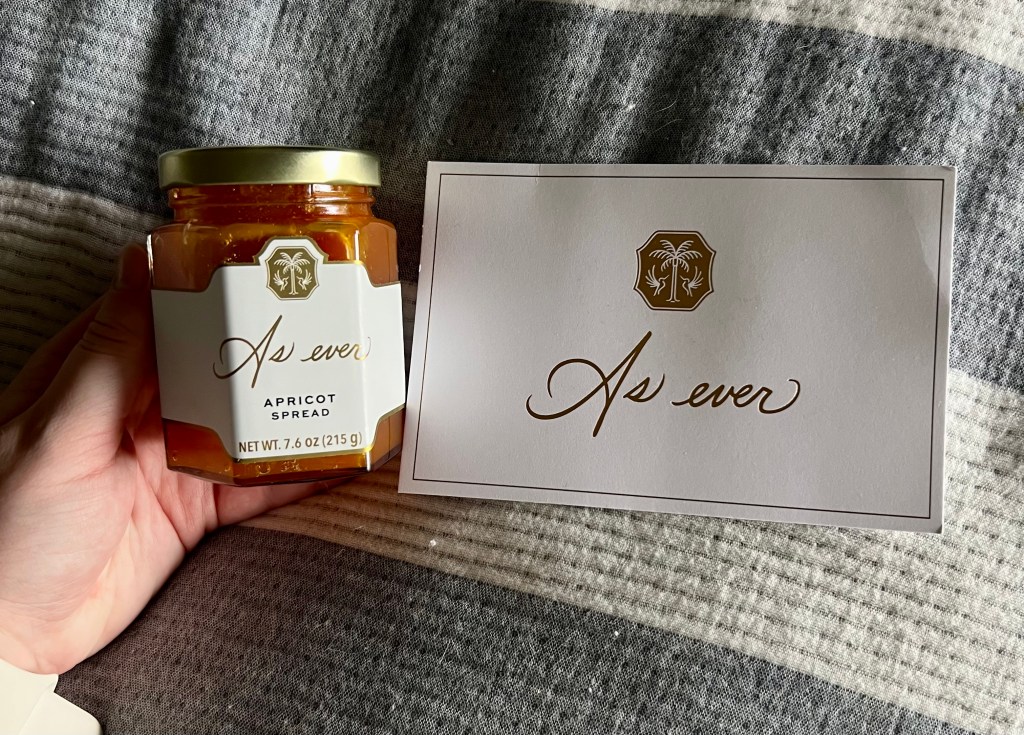
Let me just say, the box, the packaging, the glass jar? It all looked absolutely stunning upon arrival and felt high-quality. After I had a little photoshoot with the jar, I knew it was time for a taste test. 

As of this writing, I’ve tried the spread twice. Once with biscuits and once with rye toast. I will say that the apricot flavor packs a punch. A little goes a long way. I didn’t know this when I tried it with the biscuit, and was a bit overwhelmed with the tart taste of the apricot. I enjoyed the spread more with toast, as there was more surface area for the flavor to go. I could enjoy each bite without going “oh my!” I’d love to try the raspberry flavor in the future to see if that flavor packs as big of a punch as the apricot did. 

The consistency of the spread is a bit more watery than traditional jam or jelly. The jar has a wide opening, and between that and the texture of the spread, it’s easy to take a spoon or a knife to the spread and smear it onto your item of choice. The spread itself settles back into the jar beautifully. Cleanup was easy, and any excess spread was able to be wiped off with a paper towel. I’m looking forward to finishing the product and reusing the gorgeous jar in a different way! 

Overall, the apricot spread was a lovely experience for me. I would highly recommend ordering from As Ever. The customer service was incredible, the product itself was delightful, and the packaging was sturdy. Bravo, Meghan and team! 

I’ll be back this winter to discuss the upcoming With Love holiday celebration. For now, I’ll be here with my apricot spread and watching With Love season 2 again.

King of the Hill Season 14 Review: Hulu Original

An older Peggy, Bobby, and Hank pose in front of their fence.

For the first time since 2009, the Hill family is back on our television screens. In August, Hulu released the 14th season of King of the Hill, an adult animation series that originally aired on Fox. Jumping roughly nine years in the future, we pick back up to the Hill family in the current age, watching Hank and the gang navigate ride-share apps, cancel culture, and internalized misogyny. 

For those who need a refresher, the original series was focused on Hank Hill, a propane salesman, living in Arlen, Texas. He’s married to Peggy, a substitute teacher, and has one child, a boy named Bobby. He’s an avid fan of beer, grilling, and hanging out in the alley with his best friends since childhood – Dale, Bill, and Boomhauer. 

Bobby, Hank, Peggy, Luanne, and Lady Bird

In the original series, we also follow the adventures of Hank’s niece Luanne, his mother Tilly, and his father Cotton. The Souphanousinphones family, who live next door, is another prominent part of the show, consisting of Kahn, Minh, and Connie. Laotian-American, Khan and Minh both consider themselves socially above their neighbors, but slowly build a friendship over the series. Connie and Bobby are close friends, eventually becoming (on and off again) girlfriend and boyfriend. 

There are countless other side characters who are prominent in the show. Nancy and Joseph, Dale’s wife and son, are friends with Peggy and Bobby. Hank’s boss, Buck Strickland, causes chaos both at work and at home for the Hill family. Ted and Cindy Wassonasong are affluent members of the Arlen community who hold the keys to the Nine Rivers Country Club that Kahn and Minh are desperate to join. I could list these characters for days, and they’re all important in their own way. I’m personally biased to enjoying plots that include Luanne and the Souphanousinphones family. 

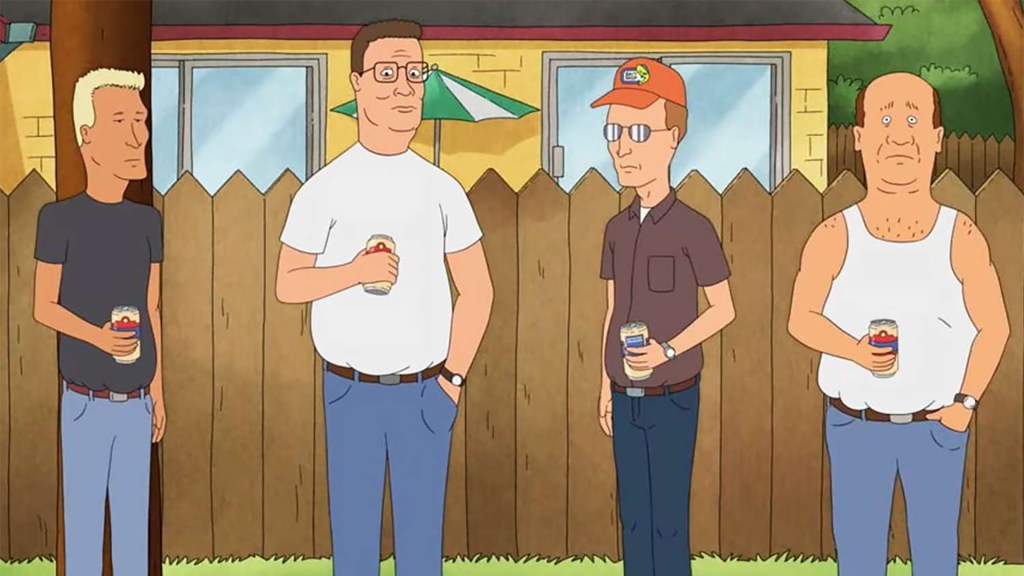
Boomhauer, Hank, Dale, and Bill in the back alley
Boomhauer, Hank, Dale, and Bill drinking beer in the back alley

The original series aired from 1997-2009. Though I consider myself a (literal) day one watcher of similar shows like The Simpsons, I don’t remember ever sitting down with my parents to watch a new episode of King. That said, I know that I had to have tuned in for episodes here and there, because there was a shocking amount from the series that I remembered. I just needed to jog my memory! For this review, I went back and watched episodes from seasons 5-9. There were multiple times, particularly in season 6, that I went “oh, I remember this!” From Bobby’s  iconic “that’s my purse” scene to Boomhauer sobbing to Heart as he drove away from a failed proposal, I found myself remembering more from the series than I ever thought I could. 

I’ve spoken to multiple people in my life who were original King watchers and were hesitant about watching the revival. Some people worried that the show would be watered down or that the original tone would be impossible to replicate. Other people were put off by the new animation or found that the show had written off too many important characters. I don’t blame original fans for their hesitation. I’m a fan of many older shows that constantly tease a reboot – One Tree Hillwas one of my favorite shows growing up, and I am hesitant about the reported revival in the works at Netflix. That said, I knew that I wanted to give King a chance. What can I say, I’m too big of an adult animation fan to let an event like this pass me by. 

The first episode of the 14th season opens with our favorite propane salesman and substitute teacher coming home to Texas after years of living in Saudi Arabia. Initially thrilled to be home and reunite with their friends, the couple is concerned that they made the wrong choice in moving back to Texas. Too much had changed since they were home last, and they’re concerned that they no longer have a place in Arlen. We jump between their struggles and check in on our beloved Bobby. Bobby is absolutely crushing it as the head chef and co-owner of a Japanese-German fusion restaurant called Robata Chane. He is happy, fulfilled, and feels successful… most of the time. Bobby is still young, and he spends this first episode wondering if he missed out by not attending college like his peers in their early 20s. 

Hank, Brian, Boomhauer, and Dale stand in front of the back alley fence.
Hank, Brian, Boomhauer, and Dale enjoy coffee in the back alley

I really enjoyed this first episode. I think it was a great call by the writing team to have the Hill family be in a transition period at the beginning of the new series. The time jump was also a brilliant idea – I’m so glad that they didn’t feel the need to keep Bobby 13 forever. Seeing the characters aged up is a little jarring at first, but believe me, their attitudes are the same. These are the same characters we know and love, just with a *tiny* bit more wisdom. 

The rest of the season follows the Hill family and inner circle get into their typical shenanigans – Bobby and Hank both enter a beer brewing competition, Peggy builds a neighborhood free little library that goes horribly wrong, Khan and Minh show up for a very memorable anniversary party, Bobby is accused of cultural appropriation, and Hank discovers that Bobby is using charcoal for his restaurant, instead of propane. *shudders*

Dale, Bill, Boomhauer, Peggy, and Hank in Boomhauer's living room
Dale, Bill, Peggy, and Hank nurse Boomhauer after a Task Rabbit, I mean Chore Chimp, job gone wrong.

Clocking in at 10 episodes, this new season is a quick and easy watch. I do hope that the following seasons will be a little longer – I wanted to spend more time with these characters! Due to this small season, we don’t see nearly enough of some fan favorite side characters. I don’t think there’s enough time spent on Hank’s friend group – I wanted to see even more of Dale, Bill, and Boomhauer. They each get one memorable plot line for the season, but I know that if we had 22 episodes, we could have gotten even more. 

That said, the new season does spend a lot of time with my favorite character, Bobby. I think it’s so much fun to keep up with adult Bobby. To see this once clumsy, class clown, goofy boy transform into a competent businessman and chef? I’m obsessed. Outside of his business, Bobby spends a lot of time in this season trying to define his relationship with Connie. Are they just friends? Childhood sweethearts destined to be together again? Neither he nor Connie is sure during the first nine episodes of the season. I’ll let you watch for yourself to see where they land in episode 10. 😉

Adult Connie and Bobby at karaoke
Adult Connie and Bobby at karaoke… as “just friends”

Tragically, multiple original voice actors had already passed away prior to or passed away during the recording of the new season. Brittany Murphy voiced Luanne, who is nowhere to be seen in season 14. Tom Petty voiced Lucky, Luanne’s partner, who is also not in the season. Johnny Hardwick was the voice of Dale and passed away during the recording of season 14. Toby Huss, a voice actor who already voiced multiple characters in the show, was appointed as the new voice of Dale. This caused quite a stir in the King fandom, but I truly couldn’t tell which voice was which. Finally, Jonathan Joss, the voice of John Redcorn, was killed after season 14 had finished recording. They have yet to announce what will be done with Redcorn for the upcoming season. 

All in all, I believe that the 14th season of King of the Hill was well done. As far as reboots have gone, this season is a stellar example of how to do one correctly. Give the audience time to refamiliarize themselves with the characters, show us how they’re doing in the current world, then create a little bit of chaos. The voice acting is tight, the plots are the right balance of grounded and outrageous, and, most importantly, the characters feel like themselves. This new season fits in right alongside the previous 13. 

Bravo to the entire King of the Hill cast and crew for a satisfying and hilarious comeback to the adult animation world. We missed you, Hank & Co. 

I Watched All of the Animated Lilo & Stitch Content, and I Have Thoughts

Note: This blog post contains spoilers for the 2025 live-action Lilo & Stitch film. 

As an avid animation lover, I have always had an extra soft spot in my heart for Stitch, the fluffy blue alien living with Lilo on the island of Kauai in Hawaii. How could such a strange little guy be so adorable? That being said, growing up without cable, I unfortunately was never able to keep up with all of the adventures that Lilo and Stitch got up to on their show, Lilo & Stitch: The Series. I never thought too hard about all of this until this spring, when I heard just how much Disney deliberately misunderstood what Ohana means. 

This May, Disney released another one of their live-action remakes, this time attempting to reimagine the modern classic that is the original 2002 Lilo & Stitch. The film was a massive box office success, grossing nearly a billion dollars. Creatively, though, the film has been negatively criticized for the changes that it made from the original. 

“Ohana means family, and family means that no one gets left behind or forgotten.” This is a line that comes up over and over again in the animated Lilo & Stitch universe. Stitch utters this line towards the end of the original film, catching Nani’s attention and convincing her that Stitch could be a member of their Ohana. It’s a beautiful reminder of the importance of family and community. This line is shown throughout the animated universe through the love that Nani and Lilo share, particularly in Nani’s commitment to raising Lilo in their childhood home. It’s shown through Uncle Jumba and Auntie Pleakley and their slow but steady adaptation to life on Earth. It’s shown through the unwavering love and loyalty that Stitch shows Lilo and vice versa. 

And Disney completely changed that for the 2025 remake. 

In the live-action version, apparently, Ohana means that Nani signs over her rights to Lilo (animated Nani’s actual worst nightmare) and goes to the mainland for school. Apparently, Ohana means taking a perfectly delightful villain like Gantu and replacing him with our beloved Uncle Jumba. And, most tragically, Ohana means that Auntie Pleakley isn’t allowed to dress in wigs or dresses because of our current conservative social climate (insert eye roll). 

After hearing about the mess that is the live-action remake, I knew it was my time to show some appreciation to the animated Lilo & Stitch universe. I’ve had a great time the last two months consuming all of the Lilo and Stitch content, watching all of the animated films, and the wonderful spinoff television series. Here, I’ll go through some highlights with you and let you know what is absolutely worth watching and what could probably be skipped. 

Lilo & Stitch at the end of the original Lilo & Stitch (2002)

Lilo & Stitch (2002) 

I mean, what can I say that hasn’t already been said? The original Lilo & Stitch is a classic for a reason. A little melancholy, a lot sweet, and absolutely hilarious. Lilo is a breath of fresh air for a lead character in a Disney film, showing that children can be fully developed people. She’s struggling with the grief of losing her parents, upset that she has to listen to her older sister, sad that the girls in her hula class undermine and bully her, but still determined to have fun and play during her childhood. Insert 626 aka Stitch crash landing onto the island of Kauai. 

I think that Lilo & Stitch has some of the absolute best side characters, particularly in Jumba and Pleakley. Enemies-to-friends (or lovers, depending on who you ask), Jumba and Pleakley are the comedic duo that this film needed. Two aliens hiding in awful human disguises in plain sight? C’mon. Plus, Pleakley in his wig is just *chef’s kiss* 

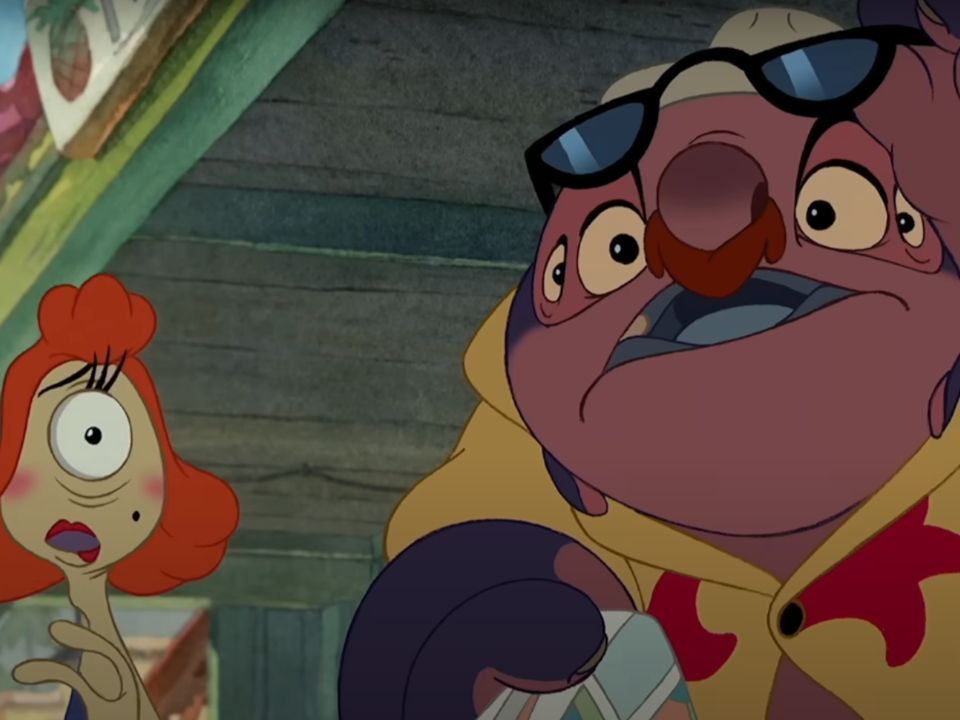
Pleakley (left) and Jumba (right) in their human disguises. Pleakley is in an orange wig and lipstick, while Jumba is in sunglasses and a fake mustache.
Pleakley and Jumba in their human disguises in the original Lilo & Stitch (2002)

This film has a shocking amount of depth for a children’s film. Family and belonging are two themes of the film, with both Lilo and Stitch struggling to see where they belong. The brief sad scenes are absolutely worth it to see the two of them come together at the end. 

My one main gripe with this film, and with the rest of the canon Lilo & Stitch universe, is that Lilo is voiced by Daveigh Chase, a white girl, while Nani is voiced by a Native Hawaiian woman, Tia Carrere. I want to make it clear that I do not blame Chase for this culturally insensitive casting choice, and I do think she does an excellent job at voicing Lilo. But Disney really missed an opportunity in the 2000s to have both Lilo AND Nani voiced by a Native Hawaiian female duo. As we know, this choice was corrected in the live-action Lilo & Stitch in 2025, where Lilo is played by Maia Kealoha, a child actor who was born in Hawaii in 2016. 

If you somehow haven’t yet, give the original Lilo & Stitch a watch. 5/5 ⭐️


Stitch! The Movie (2003) 

This film serves as the pilot for Lilo & Stitch: The Series, which I absolutely didn’t know about until after I watched the entire first season of the show (it’s okay, you can laugh). It was a direct-to-home release that clocks in at a little over an hour. It introduces us to some of the recurring characters that we’ll see throughout the series and the rest of the animated canon – Sparky, the first experiment that Lilo and Stitch catch and turn good. Experiment 625, the experiment that precedes Stitch, whose only interest is making sandwiches. Dr. Jacques von Hamsterviel, Jumba’s former partner in evil, who is determined to get all of their experiments back and keep them evil. 

Lilo & Dr. Jacques von Hamsterviel

This film is cute! It introduces Stitch calling all of the experiment pods “cousins,” which I adore. We learn a lot of Jumba lore, which is fascinating. We dive further into Ohana, with Pleakley and Jumba becoming a permanent part of the family and renovating the house for Nani. I would say that if you’re going to watch the show, you do need to watch this first. As I said, I watched it between seasons 1 and 2 and ended up going back afterwards and watching season 1 again. It fills in that many gaps! I think this film has some of the strongest writing of the animated canon and some great character development. It’s worth an hour of your time! 3.5/5 ⭐️


Lilo & Stitch 2: Stitch Has a Glitch (2005) 

I have to be honest, this is my least favorite film in the Lilo & Stitch animated universe, for a few reasons. One, our usual Lilo, Daveigh Chase, did not come back for this film, leaving Lilo to be voiced by… wait for it… Dakota Fanning? It’s an incredibly odd casting choice that doesn’t pay off, in my opinion. Part of Lilo’s initial charm in the first Lilo & Stitch film are the vocal choices that Chase makes throughout – the screaming, the laughing, the sighs. Fanning just isn’t able to replicate this. Again, I don’t quite understand why Disney used to be so committed to having Lilo be voiced by a white girl, while Nani was being voiced by a Native Hawaiian woman. But Fanning was not set up for success in stepping into this role. 

Plot-wise, the film makes me a bit sad. The main conflict involves, well, Stitch battling a glitch in his programming. The film opens with Stitch having a nightmare where he is very, very bad and ends up scratching Lilo in the face. Stitch wakes up from this nightmare, horrified, scared of himself. Maybe I have too many maternal feelings for this little guy, but it was sad to watch! Naturally, through the course of the film, Stitch is a victim of glitching within his software and does end up committing some bad acts that hurt his Ohana. Throughout the film, Lilo is preparing for a big hula showcase and wants Stitch to help her with the routine. But each time that he does, he ends up glitching a bit more and more. In the end, he’s convinced that everyone would be better off if he left the island and lived out the rest of his time in space alone. 

Obviously, this film has a happy ending, but goodness, did Stitch have to earn it! While I did find this film entertaining, it certainly puts you through the emotional ringer. It’s an important film to watch if you’re trying to watch the full animated canon (and does feature Stitch in adorable footie pajamas), but make sure to have some tissues nearby if, like me, you cry easily at animated characters in distress. 3/5 ⭐️


Leroy & Stitch (2006) 

Similar to Stitch! The Movie, Leroy & Stitch, is the finale to Lilo & Stitch: The Series. Once again, it clocks in at a little over an hour long and aired live on Disney Channel in June 2006. A lot happens in this film, so buckle up. 

The film opens with Lilo, Stitch, Jumba, and Pleakley being honored by the Grand Councilwoman for their work in catching all of the experiment pods, turning them good, and finding their one true place. As a reward, Stitch, Jumba, and Pleakley are offered positions in the Grand Federation. Lilo is obviously devastated, and all three men turn down their promotions – at first. Later, seeing how much each of them yearns for their offered position, Lilo gives them her blessing to leave Kauai and to go chase their dreams. It’s a very sweet and mature moment for Lilo. 

Jumba, Pleakley, Stitch, and Lilo being honored by the Grand Councilwoman

However, it’s not what’s meant to be. 

Slowly, Jumba and Pleakley realize how lonely they are without their Ohana. Stitch, though originally having a blast in space, deeply misses Lilo. And Lilo misses all of them, reverting back to playing with Scrump and lying facedown on the family couch. 

Enter my favorite villain in the animated canon, Dr. Hamsterviel. He has once again broken out of prison and is determined to gather up all of his and Jumba’s experiments – this time, using a brand new experiment that Jumba has just finished building, called Experiment 627… or as Dr. Hamsterviel names him, Leroy. Dr. Hamsterviel eventually masterminds a switcheroo between Stitch and Leroy (against Stitch’s wishes, clearly) and has Leroy cause absolute chaos within the planets as he successfully catches all of Hamsterviel’s experiments (Gautu could NEVER). 

Back in Kauai, Lilo knows that something is wrong with Stitch. She teams up with Experiment 625 (our sandwich maker) and the two of them set out to reunite their Ohana. 

This is a really sweet film conclusion to the television series. I can’t lie, I did cry within the first twenty minutes when I thought that the canon ended with the Ohana being separated (and not just a few tears either), but was quickly relieved when it became clear that that wasn’t where the film was going. There’s a great final battle season (very Avengers: Endgame coded) between all of the experiments and Leroy, led by Stitch, that is just *chef’s kiss*. 

I don’t think it’s a spoiler to let you know that, despite the first twenty minutes, this film does have a happy ending that reunites the *entire* Ohana, all 600+ experiments included. 💙 4/5 ⭐️


Lilo & Stitch: The Series (2003-2006) 

How corny would I sound if I said that I absolutely adore the theme song for Lilo & Stitch: The Series? I had the best time at the beginning of each episode singing along to the lyrics written by Danny Jacob & Ali B. Olmo.

“Aloha (Ji waba!)

You’ll find the place where you belong

Ohana (a family to call your own)

Where you feel at home (everybody sing!)”

Anyway! We’re not here to talk about the music, we’re here to talk about the content. Lilo & Stitch: The Series follows Lilo and Stitch as they hunt down each of the experiment pods that went flying at the end of Stitch! The Movie, as asked of them by the Grand Councilwoman. They are up against the villain to end all villains, Gantu, and his trusted sidekick, Experiment 627. The series also follows Nani as she continues to work to support Lilo, Pleakley and Jumba as they get used to life on the planet known as Earth, and Lilo as she tries over and over again to become Myrte’s friend. 

The first season of the show is pretty perfect in my eyes. Each episode got a laugh out of me, a 27-year-old woman. It’s really sweet to see Lilo and Stitch hunt down the pods, grow their friendship, and have fun along the way. Once again, Pleakley and Jumba steal the show for me a lot of the time with their alien antics and Earth musings. The only character I think gets the short end of the stick is Nani. Nani is oftentimes reduced to simply being the nagging older sister or is shown having to run off to work for the episode. I definitely think there are some lost opportunities when it comes to Nani – to me, she feels more fleshed out in all of the films than in the show. 

The second season is where things start to go a little off the rails, plot-wise. The show has four crossover episodes with other Disney shows of the era, which caught me off guard. The shows included – American Dragon: Jake Long, The Proud Family, Kim Possible, and Recess. I was only familiar with The Proud Family and Kim Possible, but even those episodes weren’t my favorite. The plotlines didn’t feel very creative and mostly included separating Lilo and Stitch for the episode as they interacted with the crossover characters. Personally, this wasn’t why I was watching the show. I was watching the show to see Lilo and Stitch be a team, not have to defeat a villain from a show that I vaguely remember. 

That being said, I did enjoy the second season. There’s a great episode that spotlights David, Lilo gets an actual, real, human friend, and Lilo graduates from hula school. We got to see the beautiful Ohana that is the Lilo & Stitch crew, and I loved it. 

This is a great show to watch on Disney+. Especially if, like me, you didn’t have the chance to watch the show when it was first airing, it’s a great way to heal a little bit of the inner child within you. 4/5 ⭐️


The Lilo & Stitch universe, to me, feels like a warm hug. It’s funny, sweet, and safe. We get to watch Lilo and Stitch grow up throughout each film and episode of the series. We get to watch Jumba and Pleakley go from reluctant allies to true friends (or more? That’s another blog post). We see Nani continue to grow into her caretaking role and move up in her career. We even get to witness Myrtle grow a *tiny* bit. 

If you end up going to see the live-action Lilo & Stitch this summer, make sure to remember the true meaning of Ohana – “Ohana means family, and family means that no one gets left behind or forgotten.” 

Running Point Season 1 Review: Netflix Original

This review contains spoilers.

The latest addition to the Mindy Kaling Television Universe landed on Netflix last week, and it’s called Running Point. Starring Kate Hudson, the sports-comedy series was co-created by Kaling, Ike Barinholtz, and David Stasse. The trio took over the production from the original creator, Elaine Ko. The show is loosely based on the life of Jeanie Buss, the controlling owner and president of the Los Angeles Lakers. 

The series follows Hudson as she plays Isla, a reformed party girl and only daughter of the famous Gordon family as she is appointed the president of the (fictional) Los Angeles Waves following her eldest brother, Cam’s, arrest and rehab stint. Hudson is joined by Brenda Song (Ali), Justin Theroux (Cam), Drew Tarver (Sandy), Scott MacArthur (Ness), and Fabrizio Guido (Jackie) as her best friend/chief of staff, three brothers, and (revealed at the end of the pilot) secret half-brother, respectively. 

The series was given the (apparent) max number of episodes a streaming show can have these days, 10, and I believe they use all 10 episodes wisely. The show’s pace is impeccable, jumping from plot to plot well. I was immediately a little skeptical of the show because I was wary of watching a sports-comedy version of Succession. I wasn’t interested in watching the privileged (white) Gordon siblings fight over control of a basketball team. But my skepticism was proven wrong by episode 2, as Sandy and Ness jointly attempt to overthrow Isla and are comically shut down by a series of smart business moves by the president herself. From there, the conflicts within the team are about everything except trying to oust Isla, which I appreciated. 

I was pleasantly surprised by how the show handled Guido’s character, Jackie. As the secret love child of the deceased Gordon, Jackie isn’t even aware that he’s a biological Gordon until the end of the pilot. His mother, one of the Gordon family’s former housekeepers, recently passed away and ensured that his biological father wouldn’t be revealed to him until her death. The kicker? Jackie begins the series as a concessions worker for the Los Angeles Waves.  

This plot could have easily gone so wrong. In the wrong hands, it would have been insensitive and perpetuated harmful stereotypes. Does anyone else remember the Arnold Schwarzenegger scandal? Just me?) But the RP writing team treats the complex topic with care. While Jackie is initially presented with a $2 million payday if he signs an NDA and agrees to never pursue a relationship with any member of the Gordon family, he doesn’t want to sign it. After the death of his beloved mother, he wants to get to know his biological family. The Gordon siblings initially reject him and only show up to an in-person meeting to get Jackie to sign the deal. Naturally, Isla breaks first and tells Jackie not to sign the deal. Jackie then joins the family business alongside his siblings – he’s once again working for the Waves, this time as Isla’s assistant. 

The series also features a Kaling universe favorite – a good old-fashioned love triangle. Isla is engaged to Dr. Lev Levenson (Max Greenfield), a kind and supportive pediatric doctor. They’ve had a long engagement (because of COVID and both of their mother’s getting facelifts, of course). In one scene we watch Isla talk through her work problems with Lev, and in the next, she is eyeing Waves head coach Jay Brown as he does (admittingly, impressive) pull-ups. The two men are mostly unaware of each other and don’t interact – I mean, Jay attends Isla and Lev’s engagement party in episode 5. So far in the series, this triangle only exists in Isla’s mind, but anyone who has seen a romance movie knows where this plot is going. 

Onto basketball. Let me preface this portion of the review by saying that I am not a big sports person. The only team I keep up with is my college alma mater, and that’s only for football. I don’t know much about basketball, but I’ve seen a lot of One Tree Hill, so I know what basketball should look like on screen. 

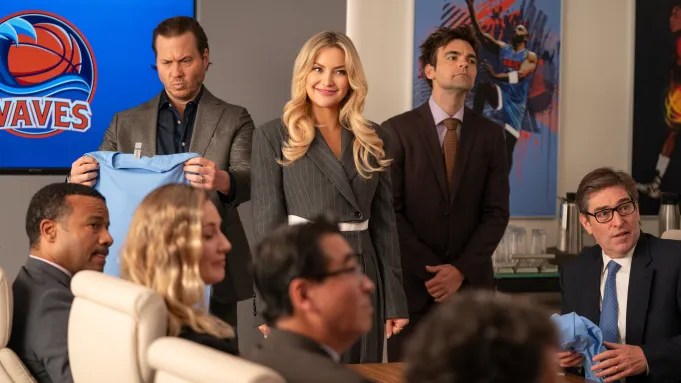
Four of our main characters: Isla, Sandy, Ness, and Ali

The team dynamic on RP is giving Ted Lasso. We have Toby Sanderman as Marcus, the star player who starts off the series as a Roy Kent shadow. Chet Hanks (yes, of THE Hanks family) is Travis, an obnoxious sexist but great player who has a strange amount of chemistry with Isla. Dane DiLiegro is Badrag, the player who gives us the most amount of funny one-liners. Honestly, the team plotlines are a little lacking. This is something that should be reworked in a potential second season. 

Ben Travers of IndieWire gave Running Point a C+ rating and pointed out that “a shocking number of Waves players look better suited for the NFL, but you’re able to suspend disbelief because you don’t have to see them hoop… until the finale decides to spend one-third of its run-time watching stiff and stout actors do their best impression of agile and altitudinous athletes.” I have to agree. When I saw that there were less than 10 minutes left of the season finale and the team was still playing, I knew we were in for a rushed ending. Chet Hanks isn’t even in the finale, dammit! 

If I were to go the IndieWire route, I would give the first season of Running Point a solid B. It’s fun, mostly silly, and has the perfect amount of drama. I like a lot of the cast, (Tarver is a particular favorite of mine from his last show, The Other Two) and I particularly like Hudson when she’s doing comedy. I love to see Song getting some airtime on a platform as big as Netflix. The writing is snappy and I was never outright bored during an episode. But there were some weak plotlines, great characters being brushed aside, (Max Greenfield, you deserved more screen time) and odd time jumps that briefly confused me. 

All that said, I’m looking forward to tuning in for a second season of Running Point. Netflix, hurry up and renew this, I know you want to. 

Catch the first season of Running Point, streaming on Netflix now.

Are We Finally Getting Good Examples of Gen Z Language in Mainstream Media?

One of the defining characteristics of each generation is the slang words that are popular with them. YOLO. Lit. Groovy. Far out. Rad. Rizz. Slay. Bummer. Ate. Wicked. These words can connect us, make us laugh, or create confusion. Above us, these words seem to have a cultural expiration date. When was the last time you heard someone say or type out the word YOLO? 

Some of the most popular Gen Z slang terms are aura, banger, basic, fire, gagged, and many, many more. Gen Z *loves* their unique generational language.

I’ll address the elephant in the room right off the bat – I’m a ‘97 baby, someone stuck between millennial and Gen Z. I identify with both groups, especially when it comes to pop culture. I grew up loving High School Musical, One Tree Hill, and Glee and as an adult… also really love those things. With a new critical eye towards them, of course. But I also am having a Brat™ summer and love to unironically use the word slay at least a dozen times per day. That last one is a problem, honestly. 

Gen Z is generally defined as children born between 1997 and 2012. Typically, Gen Z are the children of young baby boomers (like myself) or Gen X. If we’re following those years, Gen Z ranges from 12-27 years old. That’s quite a large gap, which partly explains why people born in the late 90’s may be caught off guard by what slang someone born in 2010 may use. 

I’d be remiss to mention that a lot of Gen Z slang in particular does take inspiration from AAVE (African-American Vernacular English) and the queer community, specifically from drag queens. Slay, for example, is from the drag scene in the 80’s and 90’s. Thank you to the queens who came before us for these words. 

As we get further into the 2020s, we’re getting more media revolved around Gen Z characters. Whether or not the actors playing these characters are Gen Z is a whole other debate. The examples I want to look at today are the show Pretty Little Liars: Original Sin and the movie Teenage Mutant Ninja Turtle: Mutant Mayhem

Pretty Little Liars: Original Sin revolves around a group of teenage girls born in the 2000s. The girls are in high school and have varying interests – sports, horror films, dance, chat rooms, and, ya know, solving a 20-year-old mystery. Normal teen things. 

One of the things I noticed the most while watching season 1 of PLL:OS was the excessive use of film quotes and references from the character, Tabby, in particular. Tabby works at the local movie theater and has a passion for film, horror films in particular. She almost excessively finds a way to tie everything back to a horror film throughout the season – telling herself she’s a “final girl” while entering a dark staircase, making a gender-swapped tribute to Psycho for her film class, or encouraging her classmates to attend a Jordan Peele double feature that she hosts.

Honestly, these references pretty much all landed for me. I don’t mind a little meta-commentary in a show, and her character reminded me a lot of the new characters we see now in slasher films like Scream VI. She’s the member of the group who thinks she’s smart enough to save everyone from the killer and she wants everyone to know that. She’s seen the classics, the remakes, and the reboots, and she can get them all out alive. 

Many of the comments I saw about Tabby on the TV Time app expressed annoyance at her references and quotes. They ranged from wondering how a teenager could know all of these movies, to wanting her to shut up. In my experience, with the rise of apps like TikTok and Letterboxd, I think it’s more common for teenagers to watch a lot of films and have strong opinions of them. I genuinely believe that Tabby has seen all of the movies she’s referencing – now, do I believe all of the teens on the show have? Absolutely not. But it makes Tabby’s character stand out and ties back to her main plot line very well. 

Throughout the show, we see a lot of arguing among the teens, particularly between boys and girls. We see boys telling girls to “chill out” and, in one particular confrontation, a boy asking if Tabby is trying to “win the award for angriest black girl.” I think this is a pretty good representation of how teenagers tend to argue these days – as a more socially conscious generation, Gen Z knows the hot topics to push while in a heated confrontation. When I was in high school, the boys would make misogynistic jokes, make fun of our feminist club, and tell us that “feminism wasn’t real.” I believe that teens today have an even sharper eye on contemporary gender dynamics and could draw on deeper social issues to cut deep and evoke a stronger reaction from their opponents. 

Overall, I believe Pretty Little Liars: Original Sin is a good representation of Gen Z as a whole, particularly how they use, and occasionally weaponize language. The characters aren’t using slang just to use slang. Their dialogue feels more natural than that. Perhaps since the show is structured as more of a mystery than a comedy, we don’t see the writers trying to force in Gen Z slang to get a cheap laugh from the audience. We see the characters using it amongst themselves, either when they’re feeling comfortable or when they’re defending each other. The adults in the show aren’t using it to embarrass their kids and the mysterious “A” doesn’t use it in their texts to the girls. It’s used sparingly, which I think is the smartest thing that the writers could do. 

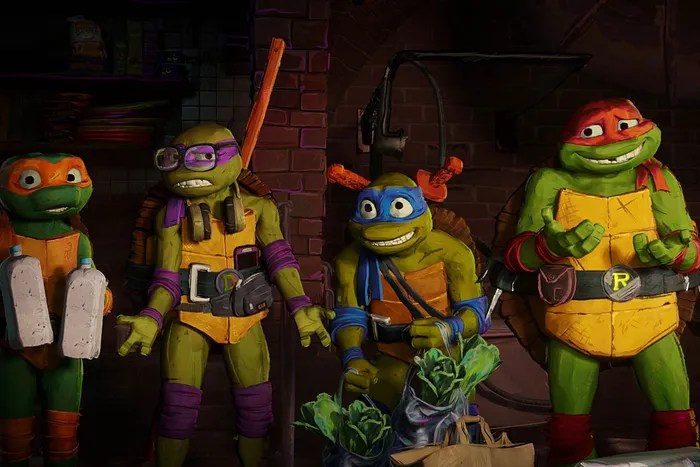
Teenage Mutant Ninja Turtle: Mutant Mayhem takes almost the opposite approach to PLL:OS, to similarly successful results. Brothers Michelangelo, Leonardo, Raphael, and Donatello are chronically online teenagers who love to use Gen Z slang. They scroll TikTok, they roast each other constantly, and they spend their free time imagining what it would be like if they could be normal teenagers. 

Look at these cuties! I love them!

Teenage is a fascinating example because the voice actors for the mutants are actual teenagers! While recording their lines for the film, each actor was younger than nineteen years old. Their young voices, whether laced with sarcasm, melancholy, or longing are part of why this movie works as well as it does. You believe the brothers would gang up to tease Donatello for having no “rizz,” for example. 

Teenage relies heavily on slang throughout the various character interactions in the film. Not only do the brothers use it amongst themselves, but they’re nervously using it while speaking to April (voiced by Ayo Edebri, our Irish queen) and while trying to connect with the new mutants they meet throughout the film. It slips out unconsciously, effortlessly fitting into the dialogue. That being said, I don’t believe it ever becomes too much or ever becomes cringe. And a movie like this could so easily become cringe. 

I have to give a specific shoutout to the film’s writers for making this all seem so natural – Seth Rogen, Evan Goldberg, Jeff Rowe, Benji Samit, and Dan Hernandez. Bravo all around. 

For every good example of good Gen Z representation, there are ultimately three bad examples. Screenwriters across the world are still trying to see what works and what doesn’t when it comes to media based on this age group. I hope that writers can see how Pretty Little Liars: Original Sin and Teenage Mutant Ninja Turtles: Mutant Mayhem utilize their teenage characters’ language, habits, and relationship dynamics and create even stronger media. 

Pretty Little Liars: Original Sin is available to stream on Max. Teenage Mutant Ninja Turtles: Mutant Mayhem is currently available to stream on Amazon Prime.

This is Me Asking You (Yes, You) to Watch What If…? on Disney+

I know, I know. The Marvel burnout is real. Believe me, I feel it too. But if you’re only going to watch one thing from Phase 4 (and Phase 5), I highly recommend you watch the animated, time-bending, multiverse series, What If…?

I first got into the MCU in 2020. We were all stuck inside, I was working a job I hated, and I felt like I wasn’t using my Disney+ account enough. I needed an escape. And what better escape than to dive into the world of the Marvel Cinematic Universe? I started to log the films on my brand new Letterboxd account (check out my MCU tag to see my ratings) and dove into this hyper fixation head first. 

I was eager to start watching the very first MCU shows on Disney+ in the beginning of 2021. This was the first time I would be watching something Marvel with my fellow fans! I was so excited. For those of you who *didn’t* stay up until 4am to watch every episode (you’re smarter than I am), WandaVision was the first Disney+ exclusive show. Then came Falcon and the Winter Soldier, then Loki. AND THEN! 

Season 1 of What If began airing in August of 2021. After keeping up with three complex shows over eight months, plus the Black Widow movie, I believe I speak for a lot of MCU fans when I say that I was a little tired of keeping up with these complex stories every week. I saw that the show was animated and thought “huh, that’s cute!” and didn’t worry too much about not keeping up. Plus, Hawkeye came out only three months later, so my focus was pulled back to the MCU with the promise of Hailee Steinfeld. 

The years went by, the MCU kept releasing shows, and the ratings went down. The critics got harsher. The fandom started to turn. Many things had changed, except one. I still didn’t feel like I was using my Disney account enough. 

I’m someone who is notoriously late to watch popular shows. The Queen’s Gambit? Eh, I’ll watch it next year. The Bear? Let’s catch up on the first two seasons right before season 3 comes out. Moon Knight, She-Hulk, Ms. Marvel? I did watch them all, but at least three months after their finale aired. I don’t know why I do this, my brain is weird. 

Cut to July 2024, nearly THREE YEARS after the first season of What If aired. I finally decided, you know what, I should check out what this show was really about. After all, the late Chadwick Boseman did win a posthumous Emmy for his voice work in the first season. It can’t be bad. 

Oh, it’s definitely not bad. 

I write a lot about animated shows on this blog. I love adult animation. I’ve been a Simpsons fan my entire life and Bob’s Burgers is another great love of mine. I strongly believe that adult animation should be taken more seriously by society in general. And What If is a fantastic addition to the genre. 

The main plot of each episode is to show us what would have happened if one key component of a classic MCU tale was different. What if Thor were an only child? What if Christine died in Doctor Strange? What if Ultron had won the battle? What if a zombie apocalypse occurred? I love this concept. I think it’s super fun and keeps the audience on its toes. 

What If stars Jeffrey Wright (fun fact: I saw him the first time I went to a taping of Late Night with Seth Meyers!) as the all-knowing Watcher. He’s the narrator of the series and has taken a vow to never interfere in any of the universes that he watches. He watches heroes prosper, worlds die, and people die, all at the same time. He’s a fascinating character and Wright was an absolutely genius casting choice. His voice is smooth and wise. As the show goes on, we reveal more of the Watcher’s personality. Wright inserts humor into the character, along with anxiety and panic. I was thrilled to see that he was nominated alongside Boseman for an Emmy in 2022. 

If I had to choose a second main character of the series, I would have to say it’s Agent Peggy Carter, played by her live-action actor, Hayley Atwell. The very first episode is titled “What If… Captain Carter Were the First Avenger?” and shows us what would have happened if Carter had been given the supersoldier serum instead of Steve Rogers. It’s a great episode and Atwell is an expert at playing Carter by this point. As the series goes on, Carter pops up time and time again. The writers of the show seem to love Carter, and I can see why! She’s reliable, witty, and strong, and a great use of the MCU’s move towards “girl power” in the 2020s. 

I think it’s important to note the voice actors in the series. Nearly every character we’re familiar with is voiced by their life-action actor. You have: Hayley Atwell, Sebastian Stan, Samuel L. Jackson, Dominic Cooper, Chris Hemsworth, Jon Favreau, Jeremy Renner, Chadwick Boseman, Benedict Cumberbatch, Rachel McAdams, Tilda Swinton, Benedict Wong, Paul Rudd, Michael B. Jordan, Angela Bassett… the list goes on. It’s great! However, lots of live-action actors didn’t come back. Josh Keaton voices Steve, Mick Wingert as Tony, and Lake Bell as Natasha, just to name a few. I’m totally fine with this. My theory is every live-action star was offered to voice their character for the animated series and either accepted or denied the offer. I don’t blame those who didn’t come back, especially those who have left the franchise on screen. 

There are some really great episodes in the two available seasons of What If. “What If… Zombies?!” is probably the fan favorite from season 1. We get to watch the surviving Avengers battle to save the universe from a zombie apocalypse – very The Last of Us coded. It’s super fun, and it features Peter Parker! I mean, what else could you want? 

Whether you’ve been lukewarm on the MCU as a whole, have never watched one of the Disney+ shows, or didn’t even know that What If existed, I think that any Marvel fan could find something to enjoy in this series. The animation is impressive, the voice acting is great, and the storylines come together for an epic finale each season. 

What If… you watched What If…?

How The Great North Pivoted From a One-Character Show to an Ensemble Animated Classic

When The Great North premiered on Fox in 2021, viewers were excited to welcome a new animated family into their lives. Starring the voice talents of Nick Offerman, Jenny Slate, and Will Forte, the animated series is set on a family living in Alaska, led by their patriarch, Beef Tobin. The other characters to round out the series are Beef’s children Judy, Ham, Moon, Wolf, and Wolf’s wife Honeybee.

The first episodes of the new series focused exclusively on young Judy, the only girl in the family surrounded by three brothers. We watched as she dealt with crushes, mean girls, and going home to the chaotic family that she adores. Almost every episode of this first season began and ended with Judy going out on the roof of the Tobin home to talk to her imaginary friend, Alanis Morissette. (Voiced by THE Morrisette. I don’t know how they pulled that off either.) The first season is a strong offering, but I will be the first to admit that I stopped watching after the season was finished. I couldn’t give you a specific reason at the time, but I can confidently say now that I was a little tired of Judy being the main focus of the show. 

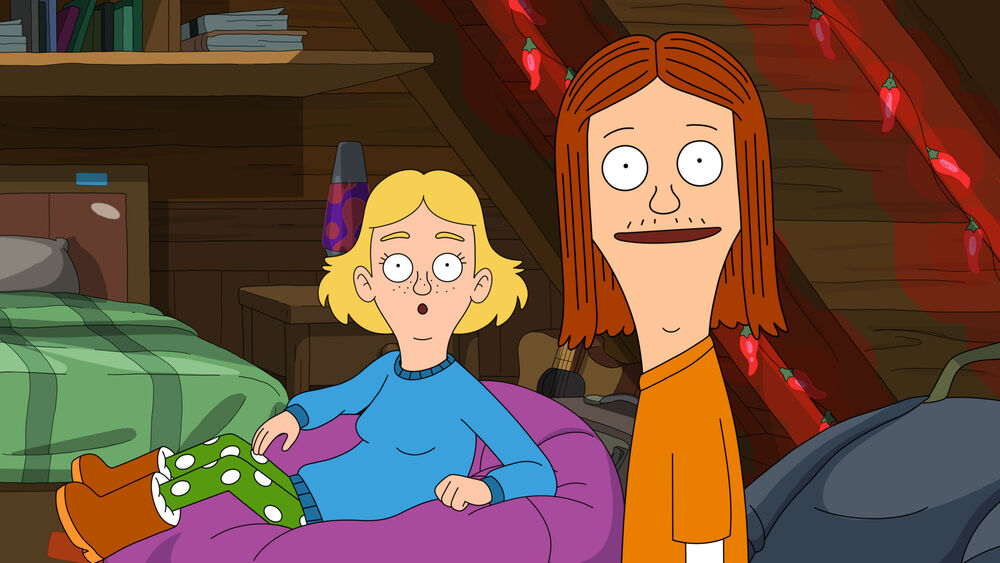
Twin siblings, Judy and Ham Tobin

Don’t get me wrong, I enjoy watching Judy and her chaos. A favorite episode of mine from the first season is when Judy develops a big crush on the new boy in town, Crispin. Crispin comes to the Tobin house, meets her family, and agrees to accompany her to the big dance… because he has a crush on Ham. A theater girl has to fall in love with a gay boy at some point, it’s just a right of passage. But for the gay boy to fall in love with her twin brother? A perfect episode if you ask me. 

I relate to Judy’s goody two shoes and try-hard nature. I do believe she brings a lot of laughs to the show. But I didn’t realize just how much the show could grow until the writers chose to shift away from Judy. 

Season two opens with another Judy-centric episode, but slowly begins to pan outward on other characters. We watch as Ham joins a punk band, Beef begins to branch out and date, Honeybee attempts to infiltrate local politics, Moon hides the siblings’ report cards because he’s failing math, and Wolf joins a children of divorced parents support group. 

We start to see individual relationships between characters become solidified throughout the season. My personal favorite pairing is Honeybee and Moon. Who would have thought that the youngest Tobin child and the newest addition to the Tobin family could get along so well? Watching these two characters bond has been one of my favorite parts of the show. 

The Great North is one of my favorite animated comedies currently on the air. It’s a great addition to the Fox lineup, especially when it’s aired alongside Bob’s Burgers. Two wholesome, hilarious, eccentric families just trying to make it in this world. I believe we need more of that.

The Great North can provide that as long as it zooms out and continues to showcase its wide variety of worthy characters.

The Great North airs Sunday nights on FOX and is available to stream on Hulu.

Why Lisa Simpson Is One of My Role Models

Note: Enjoy this quick essay I wrote as a part of my grad school application! I wanted to write something a little less serious but still heartfelt as a part of my writing portfolio. I bounced around between topics, characters, and media in my head for a while before landing on my favorite girl, Lisa Marie Simpson. Let’s hope the admissions offices enjoy it, too!

When The Simpsons premiered in December 1989, I doubt that creator Matt Groening could have predicted even an ounce of the cultural impact that the series would have over the four decades it has aired. Even more dubious, if he heard that Lisa Simpson would become a role model for a young girl born in Iowa in the 90s, I bet he would have a question or two. 

On paper, it may sound ridiculous that one of the consistent role models of my life has been a fictional eight-year-old girl. My sixth-grade English teacher laughed when I wrote that I aspired to “learn like Lisa” on a poster board meant to show her our goals for the year. But I was undeterred. I knew what she didn’t – that Lisa Simpson is one of the most influential characters on television. 

Not one of the most influential animated characters. Not one of the most influential female characters. One of the most influential characters to ever be on television. 


When the Simpson family was first shown on The Tracey Ullman Show in 1987, Lisa was her big brother Bart’s sidekick. They got into mischief together, driving their parents crazy as a team. This dynamic continued through The Simpsons first season. As a Simpsons fan would know, the series first revolved around the idea of Bart vs. Homer. Bart was the lovable rascal next door, and Homer was the hard-ass father who tried to keep him in line. Bart was essentially the main character of the show in these earliest seasons. He wouldn’t be for long, though.

The first Lisa-centric episode of the series occurs in 1×6, titled “Moaning Lisa.” It touches on heavy themes, including depression. We follow Lisa as she has a bad day at school, gets ignored at home, and sends herself to her room to decompress. While there, she hears the notes of music floating from her window. We are then introduced to one of Lisa’s role models, Bleeding Gums Murphy. Throughout the episode, we watch Lisa gain confidence and healthier coping mechanisms for her depression with music. It’s a stunning episode. Yeardley Smith, the voice of Lisa, says this episode is one of her all-time favorites. 

From here on, whenever the show turns its focus to this middle child, Lisa is learning an important life lesson. In 3×2, “Mr. Lisa Goes to Washington,” she is exposed to political corruption. In 4×4, “Lisa The Beauty Queen,” she sees the horror of vanity and the dangers of the tobacco industry. In 5×14, “Lisa Vs. Malibu Stacy,” she fights against sexism, marketing, and corporate greed. In 6×2, “Lisa’s Rival,” she grapples with her pride and the human urge to compare herself to others. 

I could go on and on, but I’ll resist. As you can see, there are many reasons why I wanted to learn like Lisa. She is unafraid to ask questions. She is brave enough to address the entire town, demand explanations, and present her ideas. She challenges corporations, small businesses, and people in power, holding them accountable for their actions. She doesn’t tamper down or hide her intelligence and passion from others. She lets herself live, big and loud, without fear of retribution. 

Lisa is a fantastic role model. At 11, I aspired to learn like her. At 26, I can confidently say I am still learning alongside her. 

Scott Pilgrim Takes Off: Netflix Original Show Review

This post contains spoilers for Scott Pilgrim Takes Off and Scott Pilgrim Vs. The World. 

I’m going to open this review with complete honesty – I wasn’t a fan of Scott Pilgrim Vs. The World

I know, I know. It’s a cult classic. I watched it for the first time in 2021 and found myself cringing more than anything else during it. I can’t exactly explain what I found so uninteresting about it, but I know that I didn’t like how Ramona Flowers was portrayed. The manic pixie dream girl of it all was a turn off for me. I was always glad that I had finally forced myself to watch it so I could participate in conversations about it, but I was certain that I wasn’t ever going to watch it again. 

When I heard that Netflix was releasing an anime version of the story this fall, I didn’t think much of it. However, I found myself interested in the concept once it became available to stream. Curiosity got the best of me, and I decided to sit down and try it out. And let me tell you…. Scott Pilgrim Takes Off is one of my favorite shows of 2023. 

But let’s back up. Scott Pilgrim Takes Off is, like the film, based off of the graphic novels written by Bryan Lee O’Malley. The first episode largely follows the film plot, with Scott dreaming of and then meeting Ramona, taking her on a date, falling asleep in her bed, etc. However, the show completely changes gears at the end of the first episode. You know how Scott is supposed to win the fight against Matthew Patel, defeating Ramona’s first evil ex? Well, he doesn’t. He dies. 

Or does he?

That is the mystery that the show sets out to solve. With Scott out of the picture, we follow Ramona as she skates around town, trying to find out where Scott really went. It’s a brilliant twist that I did not see coming. 

Ramona is a fantastic protagonist. The next few episodes open with a beautiful sequence of Ramona dying her hair a new color each morning, symbolizing where we’re going on the journey in the episode. Mary Elizabeth Winstead does great voice work opposite Aubrey Plaza, Alison Pill, Mae Whitman, Chris Evans, and Brandon Routh in these episodes. 

In these episodes, we watch Ramona track down each of her ex’s to see if they are the key to finding Scott. While confronting them, we’re treated to seeing Ramona make peace with each of them and come to terms with all that she had done to contribute to the downfall of each relationship. It’s great character development for everyone involved. 

I won’t spoil how the show ends, but I will say that it comes to a satisfying conclusion. The show is billed as a limited series and if this is the last we get of this iteration of Scott Pilgrim, I think fans will be pretty happy. 

I was shocked at how much I genuinely enjoyed this series. Honestly, it was the animation style that convinced me to give it a shot, and I’m glad I did. I’m an adult animation fan, but this is the first official anime I’ve ever watched. I really enjoyed the art style and will definitely check out more in the future.

I’ll end this review with a quick list of some of my favorite changes featured in the Scott Pilgrim show versus the film. 

  1. Ramona! She’s fully fleshed out in this show and skates straight away from the manic pixie dream girl trope. 
  2. KNIVES! Oh my gosh, what a badass. She has a fantastic plot where she ends up as a valued member of Sex Bob-omb, and it’s so fun to watch. I love that girl. 
  3. More Wallace! Who doesn’t love Wallace? Kieran Culkin is brilliant as Wallace and is featured in every episode. I love that man, and I love this character. 
  4. Less Scott —- SUE ME, I’M SORRY. 
  5. Better Scott —- The Scott we see is consistently sweet and treats Ramona (and Knives) as human beings. We love to see it. 

Have you watched Scott Pilgrim Takes Off? Were you a fan of this adaptation? Let me know in the comments!

Netflix True Crime Docuseries: Sensationalizing Crime or Necessary Viewing? 

Like a lot of modern day women, consuming true crime content is one of my guilty pleasures. I try to do this mindfully, avoiding any over sensationalized creators, stories, or pieces of media. (Looking at you, Ryan Murphy and Dahmer.) I listen to the Crime Junkie podcast every week, donate to Season of Justice, and sign petitions. The rule that I stick to when it comes to my own true crime consumption is that I want to walk away from a project and feel that I know more about the victim(s) than the perpetrator(s). That being said, I have certainly consumed my fair share of, let’s say, distasteful content. One of the main culprits of this subpar true crime content? Netflix.

Over the past few years, Netflix has become one of the main hubs for both true crime documentaries and docuseries. I love a good documentary (check out my Letterboxd to see some of my documentary picks) and have watched my fair share, ranging from white collar crime to serial killer investigations. However, I and other watchers have noticed a troubling pattern with Netflix and their true crime content. The streamer has a habit of drawing out stories into three, four, sometimes even five 45 minute episodes, devoting time to interviewing conspiracy theorists, indulging in meaningless speculation and often spending more time discussing the accused criminal rather than the victim of the crime. 

Here, I’d like to discuss a few Netflix true crime docuseries I’ve watched over the years. For the full list of the true crime content I’ve watched on the streamer, check out my Letterboxd list

*Spoilers ahead! Only keep reading ahead if you have already seen or aren’t planning to watch the following programs.*

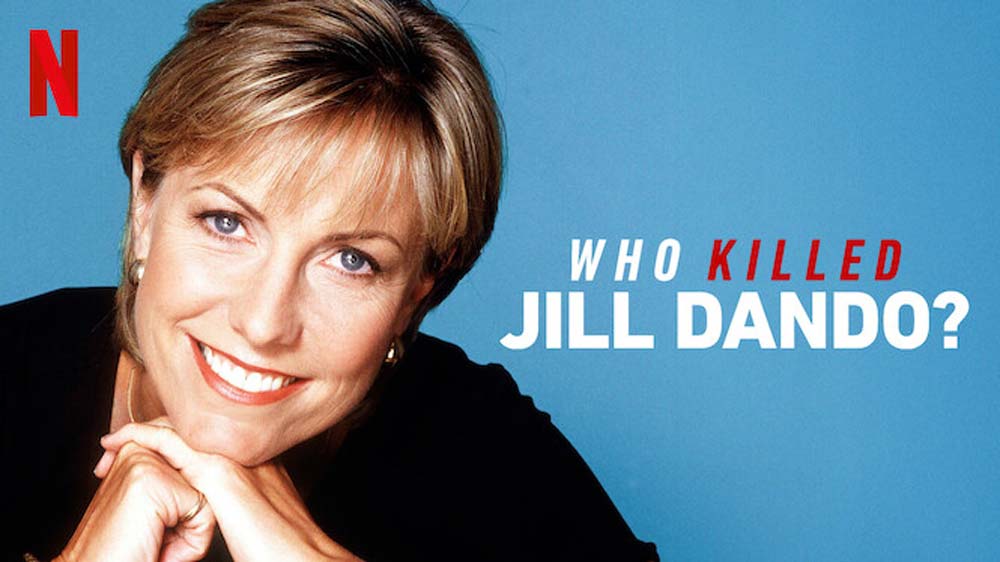
Who Killed Jill Dando? (2023)

Jill Dando is the latest Netflix original that I watched, as I took advantage of the Thanksgiving holiday to check some things off my Netflix watchlist. This is a case that I knew next to nothing about. The series consists of three 45-50-minute episodes. The first half of the first episode looked into Jill herself, a famous television presenter in Great Britain. I was a little shocked at just how famous Jill was – after her death, people said she was their Diana! Jill was murdered on her own doorstep in the spring of 1999 and her case remains unsolved. I thought this series was decently well done. I learned a lot about Jill and her career. Throughout all three episodes, they showed a lot of footage of Jill, never letting you forget about the vibrant life that was violently taken away on a normal spring day in ‘99. That said, nearly the entire third episode was spent on the man who originally spent time in prison for Jill’s murder. It was a lot of back and forth between the police who put the man behind bars and the man himself. I believe this case would have been served better as an hour-and-a-half documentary – the three episodes got cluttered, and the series lost its heart by the end. 

Do I recommend Jill Dando? Yes, actually. If, like me, you’ve never heard of this case, give it a watch.

Image courtesy of: The Independent

Crime Scene: The Vanishing at the Cecil Hotel (2021)

The Vanishing at the Cecil Hotel dives into the case of Elisa Lam, a young Canadian tourist who was found dead on the roof of the Cecil Hotel in January 2013. The Cecil Hotel, located in Los Angeles, is notorious in the true crime community. The hotel is closely located to Skid Row and is stereotyped as being frequented by houseless people and criminals. 

The disappearance of Lam and the discovery of her body have captivated the attention of millions around the world over the years. I knew a little bit about this case before I watched the series. The Crime Junkie podcast released an episode about Lam in 2018, detailing her past struggle with mental illness and the solo trip that she took to California in January of 2013. It’s been confirmed by Lam’s family that she was diagnosed with bipolar disorder and depression and was appropriately medicated by her team of doctors for the illnesses. Unfortunately, Lam had a history of not being consistent with her medication, leading to scary side effects, including hallucinations. In the end, after being missing for several weeks, Lam’s body was found in a water tank on top of the Cecil Hotel. Her death was ruled an accidental drowning, and her toxicology report found that she was undermedicated.

The Vanishing dives into Lam’s case throughout four episodes, mixing her story with background information on the hotel. On a grading scale, I would give this series a C. I have watched this series twice over the years and found it interesting each time. However, each time I’ve watched, I’ve been rubbed the wrong way by the inclusion of “internet sleuths” in the later episodes. The filmmakers chose to include interviews with multiple people who were obsessed with Lam’s case, filming the “sleuths” making their way into the hotel to “investigate.” This inclusion led their filmmakers down a conspiracy pipeline, taking an entire episode to sort it out. I don’t think this was necessary. While I do think it’s important to clear up conspiracy theories in general, the one’s features in this series have already been disproven. Their inclusion can only lead to more viewers potentially latching onto these theories, taking attention away from the facts of the case. 

Do I recommend The Vanishing? That depends. If you don’t know about Lam’s case or the history of the Cecil Hotel, I think it’s a decent starting point. If you already know about one or both topics, I say skip. Overall, I believe this series sensationalizes Lam’s story and puts the spotlight on the wrong people to keep viewers interested. 

Image courtesy of: The Crime Wire

The next time you see Netflix advertise a splashy new true crime docuseries, I highly recommend checking out the case before turning on episode one. Check to see if Netflix secured the blessing of the victim’s family for the series. If you think the series is diving into conspiracy territory, don’t hesitate to skip ahead or turn the program off altogether. Consume true crime responsibly and respectfully. Conduct research and make your own viewing decisions, but do so with the victim and their family at the front of your mind.